By COREY WILLIAMS and ED WHITE Associated Press
Storms barreling across the heart of the United States continued to threaten rain and pose flooding risks Thursday after causing at least one death when a man apparently was struck by lightning in Wisconsin.
Police in Waukesha, west of Milwaukee, said the “area was experiencing heavy rainfall accompanied by significant thunder and lightning” when someone reported seeing the man on the ground Wednesday evening.
“Preliminary information indicates the individual was struck by lightning while walking through the parking lot during the storm,” police said.
A weather pattern combining very moist air with a strong jet stream has been stretching from as far south as central Texas into the Midwest and east across the Great Lakes. From Monday through Wednesday, the National Weather Service has received more than 1,100 reports of large hail, winds above 60 mph (96 kph) and tornadoes as part of the storm system, said Bill Bunting, a meteorologist with the weather service’s Storm Prediction Center.
Teams were out Thursday surveying damage to determine the exact number of tornadoes, Bunting said.
The storms have rumbled across a number of states for the better part of this week and could continue into the early weekend.
“There’s been a tremendous amount of lightning with these storms over the last few days,” said Mark Gehring, a meteorologist with the weather service in Milwaukee.
“We’ve had the temperature and humidity of summer and it’s lasting an entire week — in mid-April,” he added. “In addition to a very stormy pattern, nearly every day we’re having heavy rain. We’ve had tornadoes nearly every day, very large hail.”
Five tornadoes have been confirmed across southern and parts of central Wisconsin, according to Gehring.
“But there are more out there. We are going out to do storm surveys,” he said Thursday, adding that storms expected Friday evening could be severe.
In addition to lightning, hail and tornadoes, the storms have brought rain — lots of it, with scores of flood warnings and flood watches issued by the weather service over multiple states.
Crews were hurriedly pumping water from a dam in Cheboygan, Michigan, this week, even removing floodgates to relieve pressure. Residents and businesses in the city were told Monday to prepare a “go bag” containing medications, documents and other important items, monitor official updates and “be ready to act” because of the threat of flooding.
In northern Michigan, Bellaire, population 1,000, said Thursday that its wastewater treatment system was being overwhelmed, forcing the release of partially treated waste into area swamps. The village urged residents to reduce home water use.
Carl Johnson, 59, has a home on the rapidly rising Muskegon River in western Michigan. He went on Facebook to tell people that his boats are ready if someone needs help.
“It’s out of the banks everywhere. It’s really bad,” he told The Associated Press. “It’s not supposed to crest until Saturday.”
People living in the river’s flood plain below the Croton Dam in Newaygo County were ordered to evacuate. It wasn’t immediately known how many people were affected.
The Wisconsin River is at major flood stage in Portage, Wisconsin, and is forecast to reach or surpass the 20.7-foot (6.3-meter) record sometime Friday morning, meteorologist Gehring said.
“Right now, it’s at 19.9 feet (6 meters), not that far off,” he said. “In Portage, there’s a large area of low-land flooding. Many roads are flooded. There’s a levee there. It’s important that the levee holds.”
Wisconsin Gov. Tony Evers declared a state of emergency earlier this week.
Cars were stranded Wednesday night in high floodwater on a highway in Milwaukee and the Milwaukee County Sheriff’s Office posted online to urge people not to drive in southeast Wisconsin.
But at least in Wisconsin, a respite could be near.
“We have one more severe, heavy rain event coming this way before we get a good break,” Gehring said. “That’s going to be on Friday evening. That’s going to be the last gasp of severe rain.”
Bunting said the storm system will continue to move north and east and likely will take three to four days to finally move off the U.S. east coast.
“Probably, the most concerning day in terms of intense thunderstorm potential and tornadoes is Friday, extending from northern Oklahoma into central Wisconsin and far eastern Illinois,” he said.
___
Williams reported from West Bloomfield, Michigan. White reported from Detroit.
News
Severe storms continue to produce heavy rain, lightning and flooding across parts of US
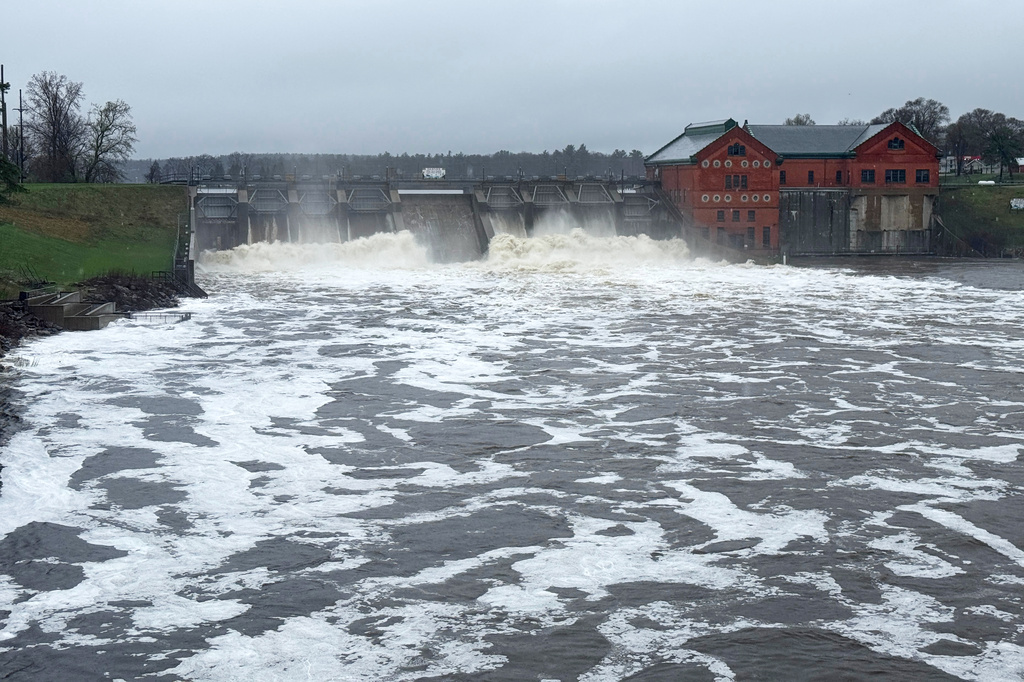
This photo provided by Bruce Carlson shows water rushing through the Croton Dam on Thursday, April 16, 2026, in Croton Township, Mich. (Bruce Carlson via AP) Photo: Associated Press