By SYLVIA HUI and BRIAN MELLEY Associated Press
LONDON (AP) — Britain will ban children aged under 16 from using a range of social media apps, including Snapchat, TikTok and YouTube, to protect them from harmful content and excessive screen time, Prime Minister Keir Starmer said Monday.
The plan was met with mixed reaction, with some praising Starmer for taking action and others questioning the effectiveness of a blanket ban.
YouTube and Meta, the parent company of Facebook and Instagram, warned Monday that a blanket social media restriction could push kids into unregulated online spaces.
“Blanket bans push kids out of such curated, supervised, beneficial experiences and towards anonymous, less-safe services,” a YouTube spokesperson said. Meta said a ban could drive teens to online spaces without any parental controls.
Starmer acknowledged the challenges, but said: “I do believe we can enforce it.”
He added: “Teenagers drink before they should, but we do not then say, ‘in which case let us abandon any attempt to stop them buying alcohol.'”
Starmer — who is under pressure to step down from members of his own party over what they see as poor leadership and could face a challenge from within his Labour Party in the coming days or weeks — acknowledged that some teenagers would try to find their way around a ban. But he said he is “not prepared to compromise on the safety and happiness of our children.”
“Every parent can see it with their own eyes. Social media is making children unhappy,” said Starmer, who has two teenage children. “I’ve heard first hand from families crying out for change and we will do right by them.”
‘Big moment for our country’
The ban, which is expected to take effect early next year, makes the U.K. part of a growing global movement to tighten online safety for children. Australia, Canada, Brazil and Indonesia have introduced legislation or announced age-based restrictions or requirements for children’s access to social media. France, Spain, Denmark, Thailand and South Korea are among others studying or developing similar approaches.
The U.K. plans to follow the same model for a social media ban as Australia, which last year became the first country to bar under-16s from holding social media accounts. Platforms that fail to take reasonable steps to exclude children younger than 16 could be punished with multimillion-dollar fines.
The U.K. said its ban will apply to platforms including Snapchat, TikTok, YouTube, Instagram, Facebook and X, but not YouTube Kids or messaging services like WhatsApp and Signal. Starmer stressed that enforcement action will target tech companies, not children.
Starmer said the move was a “big moment for our country,” adding that he will go further than Australia’s measures.
He said the government will act to prevent strangers from contacting children on gaming and livestreaming platforms. Authorities are also considering additional measures including overnight curfews and breaks in infinite scrolling for those under 18. More details are expected next month.
Some skepticism over whether a ban will work
The decision follows a public comment period in which the government received 116,000 responses from parents, the tech industry and children. More than 90% of respondents wanted an under-16 ban, the government said.
Ellen Roome, a children’s online safety campaigner whose son took his own life at 14 years old, welcomed the move. She believes her son died after an online challenge went wrong and has campaigned for legal reforms to give parents access to children’s social media accounts after their death.
“The tech companies, if they wanted to make changes, they could have done that by now. They’ve chosen not to do it,” she said. “We need to come down hard on them. If they’re not going to do it, we need to be very strict.”
But others say research in Australia has shown that age verification is difficult to enforce, and that a blanket ban seemed to be a snap decision that does not address a deeper problem — the way social media algorithms push harmful content to young people.
“This is far too easy to work around. It is based on age verification tools that have been shown to be ineffective to date,” said Kate Edwards, head of education at the Molly Rose Foundation, which was set up in memory of 14-year-old Molly Russell, who died by suicide after being exposed to self-harm content online.
“It does nothing to address the actual problem itself, the harmful algorithms, the harmful content that is existing on those platforms,” Edwards added.
Meta shares “the goal of keeping teens safe online,” a spokesperson said, adding: “Which is why we developed Teen Accounts to automatically limit who can contact them and the content they see. Like others, we don’t think bans will achieve this goal.”
Meta said the move by Australia had shown how “bans risk isolating teens from online communities and information.”
Jon Crowcroft, a communications systems professor at the University of Cambridge, said people supporting social bans are well-meaning but probably misguided, and changes could prevent children from accessing sites they need.
“There is a real risk this will drive some users to worse sites and policing devices is close to impossible technically,” Crowcroft said.
Other critics including the Open Rights Group have expressed concerns about age verification companies and how users’ private data is protected.
U.S. opposes the move
The ban could further inflame tensions with the U.S., which has warned that regulations should be narrow and not violate free speech protections, according to a statement from the U.S. Embassy in London. It said it was also concerned that regulations would place greater burdens on American technology companies.
Starmer said he expected to discuss the issue with U.S. President Donald Trump and other world leaders at a Group of Seven summit in France that starts Monday.
“I honestly think that across world leaders, there has always been a recognition that leaders have to take steps to protect children,” he said. “I don’t think that’s controversial.”
___
Associated Press writer Jill Lawless contributed to this story.
News
UK bans under-16s from using social media apps including TikTok and YouTube
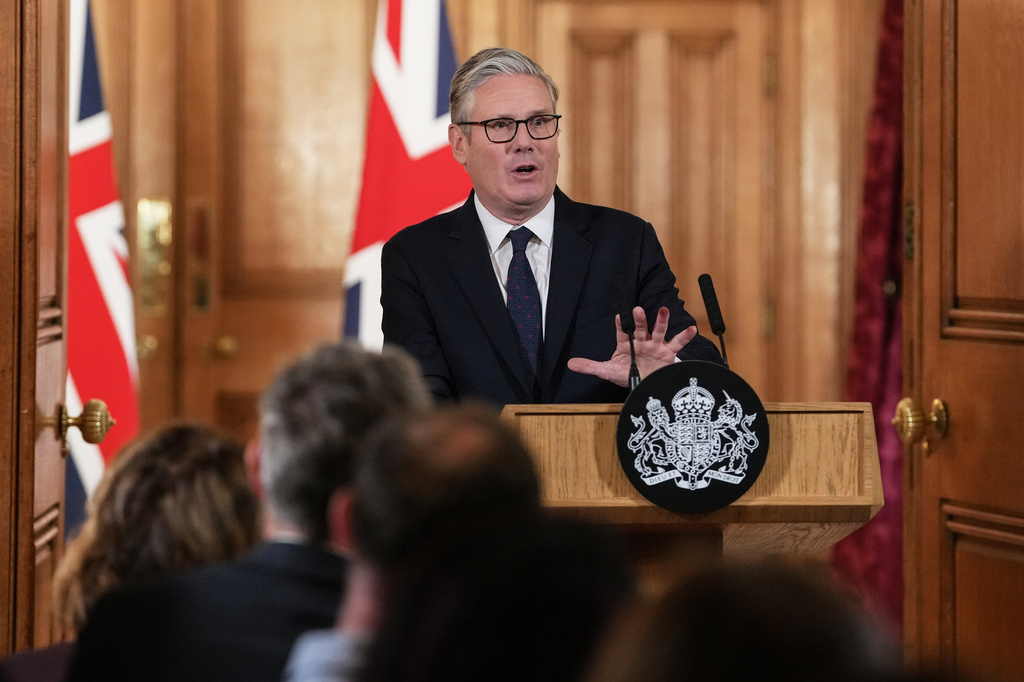
Britain's Prime Minister Keir Starmer attends a press conference to announce government action to protect children online, at Downing Street in central London, Monday, June 15, 2026. (Carlos Jasso/ Pool Photo via AP) Photo: Associated Press